Microlitres, Molarity and Ice
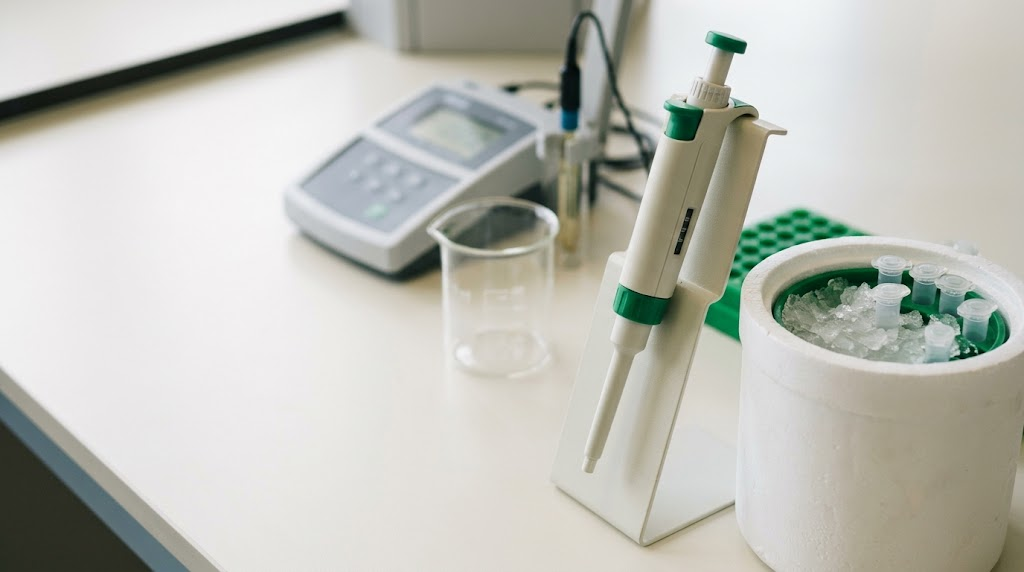
Many lab results that look like biology may actually come from technical variability, i.e. how you handle the samples. Common examples would be a volume that was never delivered, a buffer made up wrong, and a sample that warmed for ten minutes longer than the protocol. This post shares three examples that I learned and found very useful: pipetting small volumes, making a solution to the right concentration and pH, and keeping the samples cold.
Microlitres: volumes you cannot see
Below about two microlitres there is almost nothing on the tip you can check by eye. Accuracy comes entirely from good practice:
- Use the appropriate pipette whose range covers the volume, and never set a pipette below its range.
- Draw slowly holding the pipette vertical.
- Dilute the stock rather than pipetting less. For example, a primer added as 1 µl of a 10 µM working stock is more reliable than 0.1 µl of a 100 µM stock.
- Keep one rhythm across a whole batch of samples.
- Check if duplicate runs agree with each other (e.g. duplicate wells in a qPCR plate).
Molarity: making the solution you will use
Two formulas cover most recipes:
- mass (g) = molecular weight (g/mol) × molarity (mol/L) × volume (L)
- stock volume = (final concentration ÷ stock concentration) × final volume
For example, 100 ml of 150 mM sodium chloride (molecular weight 58.44) needs 58.44 × 0.15 × 0.1 = 0.88 g.
Making solutions and adjusting the pH:
- Don’t rely on mental calculation. Write down the recipe and double check.
- Weigh each powder onto a fresh boat; tare between components.
- Dissolve in about 80% of the final volume, adjust the pH, and only then make up to volume. (Adding acid or base solution will change the volume.)
- Adjusting pH needs patience.
- Calibrate the meter at two points that bracket the target (e.g. pH 7, then pH 4 or 10).
- Rinse the electrode and blot it between solutions; never rub it.
- Add acid or base in small steps and wait for the reading to settle each time.
- If you overshoot badly on a critical buffer, starting again is often better than titrating back, since every correction adds salt.
Keep everything cold
“Keep your samples cold!” is the first rule anyone learns at the bench. “Cold and clean” is especially true for handling RNA samples. The enzymes that degrade RNA (RNases) are stable, need no cofactors and are everywhere, including on your skin.
Ways of keeping your samples cold:
- Wet ice (about 0–4 °C): keeps samples and reagents cold during short bench work.
- Dry ice (about −78 °C): keeps frozen samples frozen while you handle them.
- Liquid nitrogen (−196 °C): snap-freezes samples so they freeze before RNases can act.
How to handle samples:
- Frozen samples: store at −80 °C; handle on dry ice; weigh or aliquot without letting them thaw. Repeated freeze–thaw cycles degrade samples.
- During the procedure: keep reagents, tubes or plates on ice or a cold block.
A clinician’s note
On the ward, sending samples means putting the tubes in a bag: take the sample, put it in a bag and off it goes to the lab; then “by magic”, a page of results will come back later. At the bench, pipetting solutions, handling samples and maintaining a safe and appropriate lab environment is the daily work. None of this is intellectually too hard once you know the underlying mechanism, but it is a skill learned by hand, and it takes a few errors to build the knowledge.
Trimmed protocol
Three cards (reminders, not a substitute for training or your lab’s SOP)
Sub-microlitre pipetting
- Smallest pipette that covers the volume (P2 or P10 under 2 µl). Never below its range.
- Draw slowly to the first stop, pipette vertical.
- Dilute stocks so each addition is at least ~0.5 µl where possible.
- One rhythm across a batch of samples.
- Check if duplicate runs agree with each other.
Making a buffer and adjusting pH
- Write the recipe: final concentrations, final volume, mass or stock volume of each component. Mass (g) = MW × M × V (L); stock volume = final ÷ stock × final volume.
- Weigh each powder onto a fresh boat; tare between components.
- Dissolve in ~80% of the final volume before adjusting pH.
- Two-point calibration (pH 7, then 4 or 10); rinse and blot the electrode, never rub.
- Adjust drop by drop; wait for the reading to settle.
Cold chain
- Samples: snap-freeze promptly after collection; store at −80 °C in labelled bags; log every box position.
- Frozen material: dry ice on the bench; weigh or aliquot without thawing; avoid repeated freeze–thaw.
- During the procedure: keep reagents, tubes or plates on ice or a cold block.